 In today’s world, leadership is becoming more complex than ever. As we guide our institutions, organizations, or communities into the future, leaders are expected not only to provide direction but also to cope with increasingly difficult challenges. In an environment with limited resources and constantly shifting power dynamics, cognitive intelligence (IQ) or emotional intelligence (EQ) alone are no longer sufficient. We now need a new type of intelligence: Political Intelligence (PI).
Why Do School Administrators Need Political Intelligence?
Educational environments are also subject to this complexity. School administrators must ensure the best management with limited resources, establish effective communication with various stakeholders such as teachers, students, parents, and non-governmental organizations. In this multidimensional structure, where there are many written and unwritten rules within the school culture, managing strategic interactions requires great skill. At this very point, it is vital for administrators to use their political intelligence to minimize mistakes and access the necessary information and opportunities for the school.
What is Political Intelligence Leadership and What Are Its Dimensions?
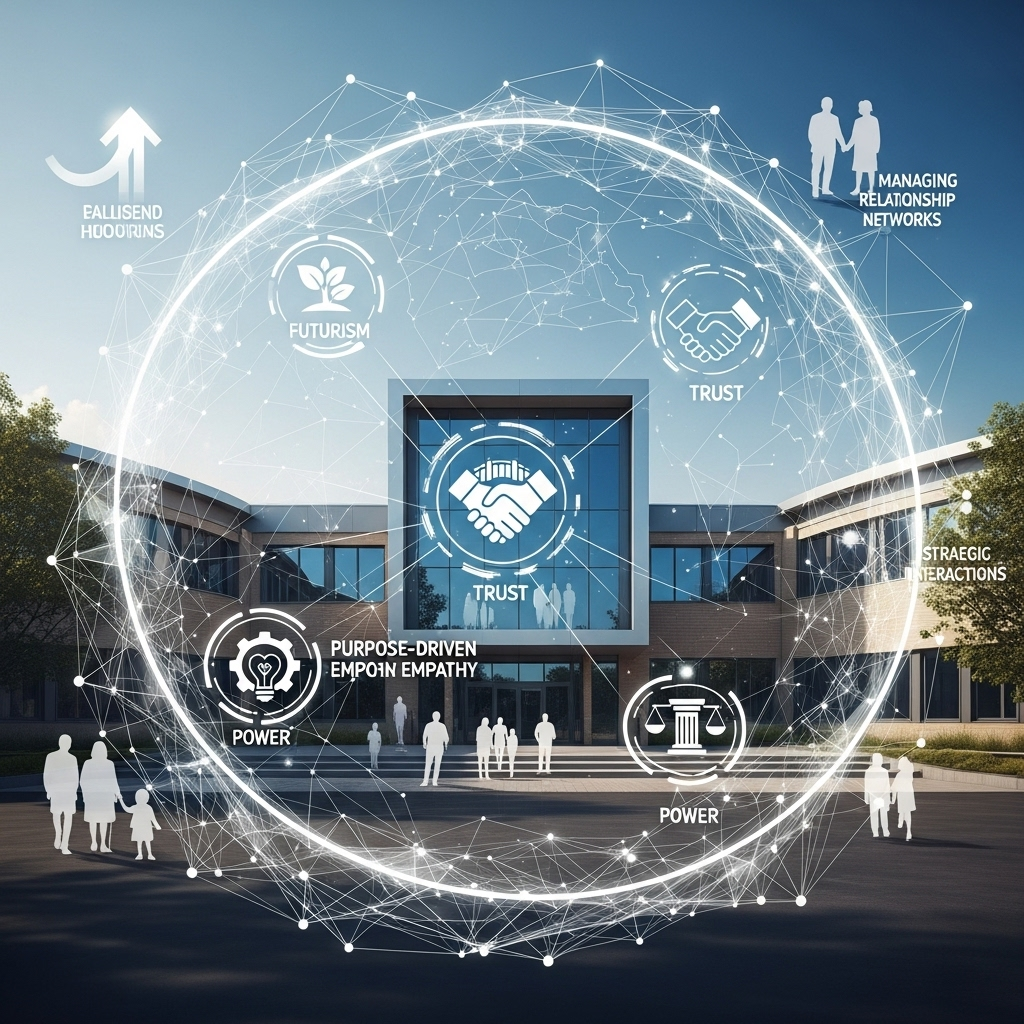
Political intelligence is a type of intelligence that enables strategic interactions in a world where power is shared, to shape the future. This intelligence carries a social meaning, bringing richness and effectiveness to leaders who communicate and interact with various communities. When defined as a type of leadership, Political Intelligence Leadership refers to a leader who works for the continuation of the school’s existence and future generations in better conditions, influences the environment for this purpose, and establishes strong relationship networks with the environment. More briefly, it can be defined as the type of leader who influences the environment for future generations and manages relationship networks to achieve more.
This leadership style is examined in four main dimensions:
• Futurism: This dimension is about leaders considering future generations and knowing how to create the conditions for a better future.
• Trust: It stands out as an element that binds and strengthens relationships. In situations where positional power is not enough, building trust within relationship networks is critical for achieving more for the common good.
• Purposeful Empathy: This means establishing strong and trusting relationships with stakeholders towards a common goal and utilizing these relationships to achieve mutually beneficial outcomes.
• Power: This refers to the ability to build relationships and influence stakeholders to shape the future for both institutional and societal benefit.
A New Tool for School Administrators: The Political Intelligence Leadership Scale
So, how can we measure the political intelligence leadership skills of school administrators? The answer to this question comes from research that developed a valid and reliable Political Intelligence Leadership Scale (PQLS). This study, conducted with 597 teachers and school administrators in Denizli, provides this scale, which aims to reveal school administrators’ ability to manage strategic interactions. Through this scale, it will be possible to better understand how administrators influence the environment for future generations and manage relationship networks to achieve more.
Conclusion and Future Outlook
Political intelligence leadership is an indispensable competency for school administrators to achieve success, especially in a dynamic and stakeholder-focused field like education. This new scale is a powerful tool that will enable administrators to evaluate and develop themselves in this area. Future generations, strong relationship networks, and common interests are the keywords around which political intelligence leadership is shaped, and it can be one of the keys to leading our schools to a brighter future. Developing these skills in school administrators will contribute not only to schools but also to the development of society as a whole.
Listen As A Podcast